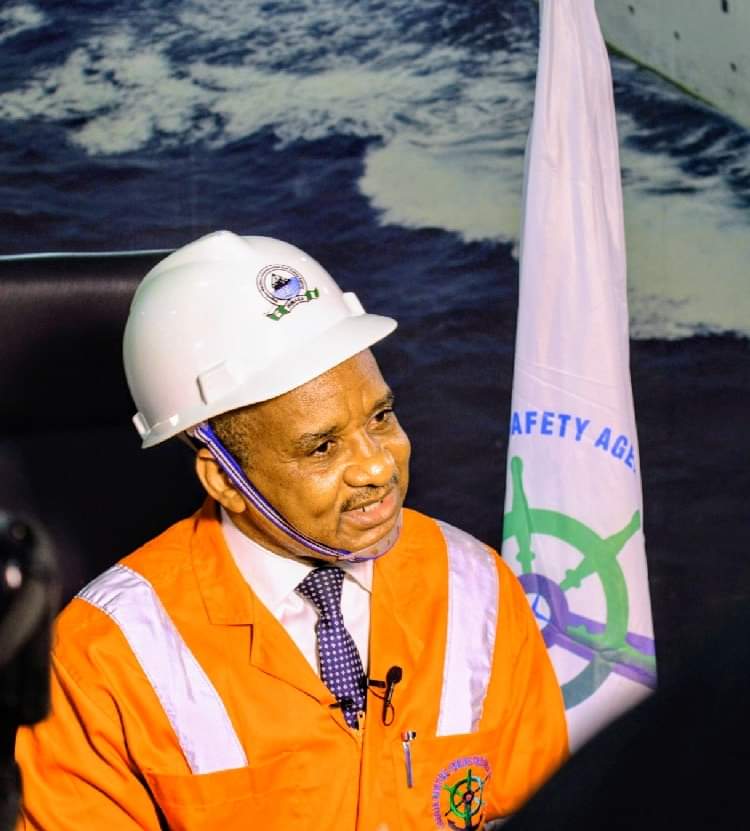

The three years of the administration of Dr. Bashir Yusuf Jamoh, OFR, as the Director General of Nigerian Maritime Administration and Safety Agency (NIMASA) has without doubt heralded so many laudable achievements in the regulations of maritime activities in Nigeria.
His display of professionalism in ensuring safe and secure shipping through domestication of enabling laws and provision of infrastructural facilities is legendary.
NIMASA’s two cardinal objectives, namely i.Regulation and promotion of maritime safety, security, marine pollution and maritime labour. ii. Promoting the development of indigenous Commercial Shipping in International and Coastal Shipping Trade have been excellently achieved under Jamoh”s pragmatic leadership. No wonder the agency has been recording successes in all its core functions.
This lends credence to the calls by maritime stakeholders that the unassuming NIMASA boss deserves to be given a second term.
The stakeholders extolled his exceptional performance and therefore demanded that he should be retained by the Tinubu administration and given second term at the expiration of his first term next year.
A major stakeholders’ group and foremost maritime union, the Maritime Workers Union of Nigeria (MWUN) stated that the leadership of NIMASA under Bashir Jamoh has excelled in staff welfare, regular staff promotion and in attending to the needs of stakeholders.
Speaking at a ceremony in Lagos recently, the President General of MWUN who doubles as the Deputy President, Nigeria Labour Congress (NLC), Prince Adewale Adeyanju, said emphatically that based on Jamoh’s performance, he deserves a second term in office.
Adeyanju lauded the NIMASA boss for making dialogue a way of life in the agency and for ensuring seamless resolution of labour related issues.
His words: “Based on performance, Jamoh deserves a second term in office. His achievements speak volume. We have been watching you and we know you have the track record of fulfilling your promises. We charge you to continue as the union will continue to support the humanitarian policies of your management.”
Truly NIMASA has achieved a lot under Jamoh.
Within the three years that he has been in the saddle (2020 and this year), NIMASA has signed Memorandum of Understanding (MoUs) on the recognition of Certificate of Competency (CoC) and Training of Seafarers between Nigeria and Sixteen countries.
These MoUs and CoCs, according to Assistant Director Public Relations of NIMASA, Osagie Edwards, are aimed at expanding opportunities for international level job placement for holders of Nigeria CoC while also causing Nigerian skilled maritime manpower deployment in addressing global challenge of declined number of seafarers.
NIMASA has achieved the automation of the registration process of Shipping Company/Agents resulting in Certificates being embedded with QR Codes for authentication.
This has successfully eliminated the back and forth incidents of alleged fake certificates in the past and has enthroned greater level of integrity and accountability in the certification process.
NIMASA has also brought Nigeria to speed in the maritime world with ratification of 6 conventions. Under Dr Jamoh led Management, NIMASA in the last three years have doubled Nigeria’s momentum for a viable blue economy that seeks to harness maritime potentials for economic sustainability and growth.
While Jamoh’s implementation drive has earned Nigeria some accolades, it is noteworthy that a lot couldn’t have been achieved without reliable legal backing either as legislations or international conventions which Nigeria acceded to. Not less than 6 International maritime conventions have been ratified by Nigeria for proper governance of the country’s maritime space.
These ratified conventions spell out proper mode of governance for various areas such as standards of training ,certification and watch keeping for the fishing sector, pollution management and carriage of passenger luggage by sea.
Nigeria has ratified Hong Kong International Convention for the Safe and Environmentally Sound Recycling of Ships 2009; International Convention on Standard of Training, Certification and Watch-keeping for Fishing Vessel Personnel (STCW –F) 1995;Protocol Relating to Intervention on the High Seas in Cases of Oil Pollution Casualties (Intervention Protocol)1973; Protocol on Limitation of Liability for Maritime Claims (LLMC)1996; Protocol to the 1974 Athens Convention relating to the Carriage of Passengers and their Luggage by Sea 2002; and Protocol of 2005 to the 1988 Protocol for the Suppression of Unlawful Act against the Safety of Fixed Platforms located on the Continental Shelf (SUA PROT 2005)
Within the three year period, the agency also concluded the review of 49 Regulations made pursuant to the Merchant Shipping Act, 2007. Laws in this category specifically sought to protect interests of indigenous professionals and investors in the maritime industry with first choice opportunity preferences.
It also bridged operational gaps between the maritime sector and other area while fostering inter agency collaboration with other federal government owned organisations
Jamoh and his team have succeeded in Executing some Memorandum of Understanding between the Agency andNigerian Meteorological Agency (NiMet), Nigerian Institute ofTransport Technology (NITT) and the National Oil Spill Detection and Response Agency (NOSDRA) amongstothers.
The agency’s deliberate drive to educate and strengthen judicial officers on how best to handle admiralty cases was not left behind in the period under review.NIMASA successfully hosted the Annual Nigerian Admiralty Law Colloquium in collaboration with the Nigeria Institute of Advanced Legal Studies (NIALS) and the National Judicial Institute (NJI) for the years 2021, 2022 and 2023.
On anti piracy, NIMASA championed implementation of the Suppression of Piracy and Maritime Offences (SPOMO) Act, 2019 which has enhanced safer and secured trading routes through the Gulf of Guinea region and ensured proper prosecution of a sizeable number of cases such as FGN v BINAEBI JOHNSON & 8 Ors and FGN v FRANK ABAKA & 9 Ors.
This landmark SPOMO Act by Nigeria is presently being studied by other maritime administrations owing to its huge success in fighting piracy with a rich legal framework that is marked with successes since implementation began.
Beyond the shores of Nigeria, notable global maritime personalities like Kitack Lim, the Secretary of International Maritime Organisation (IMO) and Dr. Paul Adalikwu, Secretary General of Maritime Organisation of West and Central Africa (MOWCA) have recommended the SPOMO Act model to other African countries.
All these achievements under the leadership of Dr Jamoh and his team shows an Agency focused on the use of the instrumentality of the Law to enhance the values Nigerian maritime industry adds to the Nation’s economy.